
Enterprise AI
A Scheduling Agent Drafts the Rota: How Much Can Managers Change?
Retail chains use a store scheduling agent to produce staff rotas, and store managers keep some room to adjust them on the floor. Small same-role tweaks and shift swaps for leave can be made directly. Changes that create overtime, long runs of consecutive workdays, or broken rest intervals are blocked by the system and sent to a supervisor for approval. The change records feed a review of the rules.

After a store scheduling agent produces the shift rota, how much the store manager can change depends on the risk of each change. The algorithm calculates staffing needs from forecast foot traffic. On the floor, the manager can swap people in the same role or shift start and end times slightly. Changes that cause back-to-back shift fatigue, overtime, or broken rest periods are blocked by tier, and the system sends them to the area supervisor for approval. Setting up tiered adjustment rights gives the floor flexibility and prevents labor disputes.
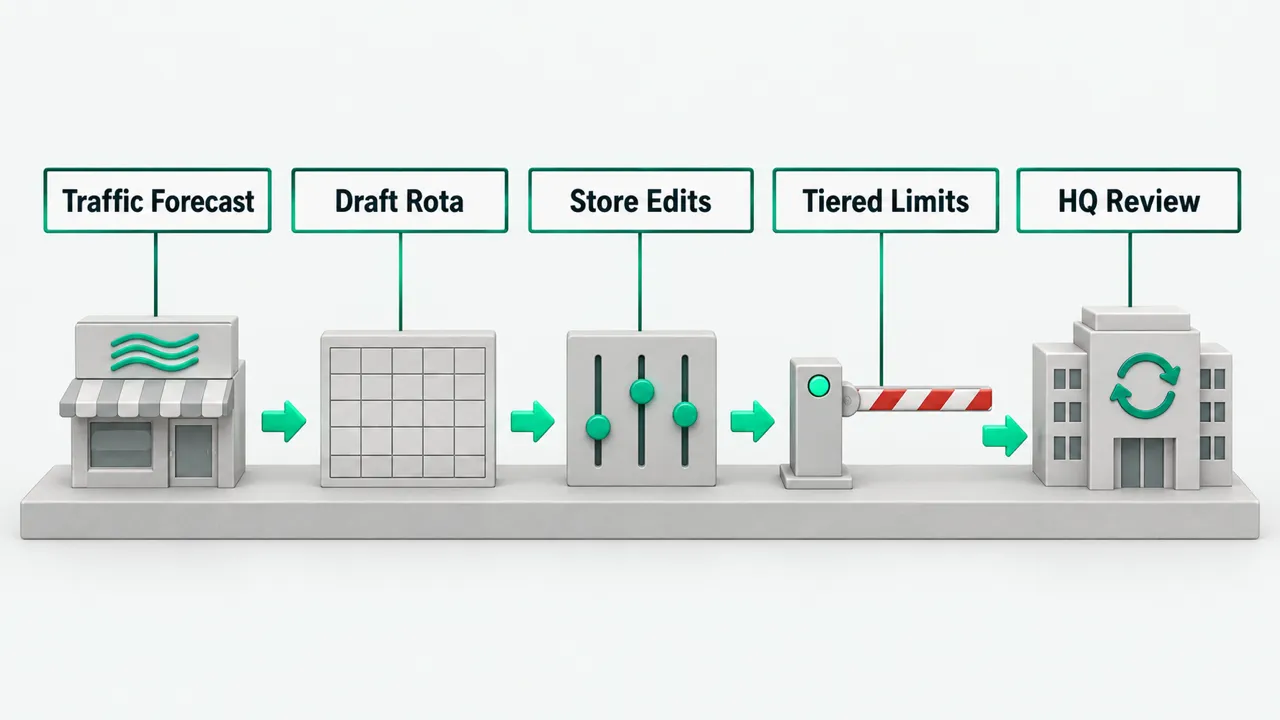
Read the traffic forecast and availability: calculate base labor hours
The program connects to historical order data in the sales system and to foot traffic sensors. For each trading period, the system reads store visits, checkout transactions, and delivery orders, and calculates how many staff each period needs. For holidays or bad weather, the system raises or lowers the labor estimate using swings from the same period in past years.
The program also pulls employee records and availability. Contracted hours for full-time staff, the periods part-time staff can work this cycle, health certificate expiry dates, and role skill qualifications are all checked before scheduling. If a part-time employee marks a period as unavailable in the system, the program marks them unschedulable for it, to avoid assignment conflicts.
The headquarters operations department sets the base labor productivity targets and trading hour rules. Operations experts set the minimum staff needed for opening prep and closing, and these hard trading constraints become boundary conditions for the scheduling calculation.
Match skills and generate the rota: set the lineup for each period
The program matches labor hour needs against staff on the roster under several constraints. The system arranges baristas, cashiers, and kitchen prep staff across peaks and lulls. It schedules full-time staff’s standard hours first, then fills traffic peaks with flexible part-time staff. For the pace of granting the system access to HR and scheduling tools, see Agent Permission Management: How to Set Tool Access Levels and What to Grant First.
The generated rota appears on the in-store management terminal. For each period, the program shows the staff on duty and their areas, along with each employee’s cumulative hours for the cycle, and checks for overly long runs of consecutive workdays. The system sends the draft rota to the store manager.
The store manager does a first review of the rota. The manager knows each employee’s skill level. If a peak period has two brand-new hires on it, the manager adjusts the pairing by hand.
Daily tweaks and swaps on the floor: the manager’s own room to change
The store manager has direct authority to reassign people within the same role. When an employee falls ill and takes sudden leave, or two employees with the same skills agree to swap shifts, the manager makes the swap on the handheld terminal. As long as neither employee exceeds the hours cap and both meet the rest interval after the swap, the system approves it on the spot and updates the rota.
The system requires the manager to tick a reason tag for each change. The options are standard categories such as personal leave, skill coverage, and temporary cover. After the manager picks one, the system keeps the change history automatically. Once the change is made, the system sends a confirmation card through the mobile work platform to each employee affected.
The employee completes the swap by tapping confirm on their phone. If the employee does not confirm within the set time, the system prompts the manager to call and check, so managers cannot change someone’s hours without their consent.
Tiered blocking at the labor-hour floor: high-risk changes go to approval
If the store manager tries to produce a rota outside the safe range, the system blocks it by rule. Examples are scheduling the same employee for many consecutive workdays without a day off, or total hours in one cycle approaching the legal limit. The system marks the error in red on screen and prevents the manager from submitting it. Once a rota takes effect, employees work by it, and an execution error is harder to fix than a bad recommendation. For the management boundary, see AI Agent Security Governance Must Come Before Scaling.
For extreme situations such as an emergency stockout count or urgent equipment repair, the system offers an exception approval channel. The store manager files an over-limit request in the system with the overtime reason and the compensation plan. The request goes straight into the area operations manager’s approval flow. Only after the area manager approves and signs electronically does the system lift the block and update the rota.
The area operations manager carries management responsibility for over-limit approvals. The manager approves only after confirming the store’s report is accurate and no other cover is available, to prevent compliance risk from overworking staff.
Collect change records and tune the rules: headquarters adjusts parameters on a schedule
Change data from all stores rolls up to the headquarters data platform each cycle. The system counts how often each store changes shifts, which periods the changes cluster in, and the most frequently chosen reasons, and generates a scheduling deviation report. The system flags stores and roles with unusually high manual change rates.
The headquarters scheduling project team and labor relations experts analyze the causes of deviation. If many stores frequently add staff by hand in a specific period, the traffic forecast model is systematically underestimating, and engineers need to correct the forecast algorithm’s coefficients. If some part-time employees are often scheduled wrongly and drop the shifts, the availability collection process needs improvement.
The operations director leads scheduling rule calibration on a regular schedule. Using the latest attendance statistics and business changes, the team adjusts the base model for each store type, so the algorithm’s rotas fit daily operations more closely.
Store scheduling agent: FAQ
Why not let store managers freely change the rota a store scheduling agent generates?
If store managers have unlimited edit rights, scheduling easily slides back to personal preference and favors. Scheduling without system constraints tends to overload some employees with overtime and leave some part-time staff short of hours. It can even break legal rules on rest time and overtime, which exposes the company to labor disputes. The system holds the floor and the manager makes small adjustments. That keeps both floor flexibility and company standards.
When an employee takes sudden leave or foot traffic surges, how does the manager adjust the rota on the spot?
When an employee is suddenly absent or traffic surges, the store manager can open the emergency cover channel in the admin console. From the part-time pool and the list of idle employees at nearby stores, the system recommends people who are close by, qualified for the role, and currently off shift. The manager sends an emergency request with one tap, the system pushes a cover notice, and an employee who accepts is added to the current rota automatically.
When a chain rolls out automated scheduling to stores across regions, who sets the labor-hour compliance rules?
The legal team in headquarters HR and the operations standards committee jointly set the base labor-hour compliance rules. Working hours, overtime pay for rest days, and limits on consecutive workdays all follow local regulations and company policy, and these requirements are turned into constraint parameters in the system. Regional branch heads propose parameter adjustments based on local policy, and after headquarters compliance approves them, they are written into the scheduling system back end and applied across stores.