
Enterprise AI
An Agent Exceeds Its Authorized Scope: Downgrade It or Stop It?
When a company running automated systems finds an agent acting beyond its authorized scope, it needs tiered responses based on impact. A minor read-only overreach can be handled by revoking a single tool permission and running in a downgraded state. High-risk writes or external actions call for an immediate stop and frozen credentials, and the security lead decides on recovery after finding the root cause.

When an agent breaks out of its authorized scope at run time, the response cannot be a blanket shutdown. If the agent only read an unauthorized reference directory, shutting it down may break the whole business chain. If it wrote to a database without authorization or sent commands to external customers on its own, every minute of delay makes the loss harder to recover. A company needs tiered responses: downgrade and revoke permissions, pause the instance, or freeze credentials, depending on how serious the overreach is.
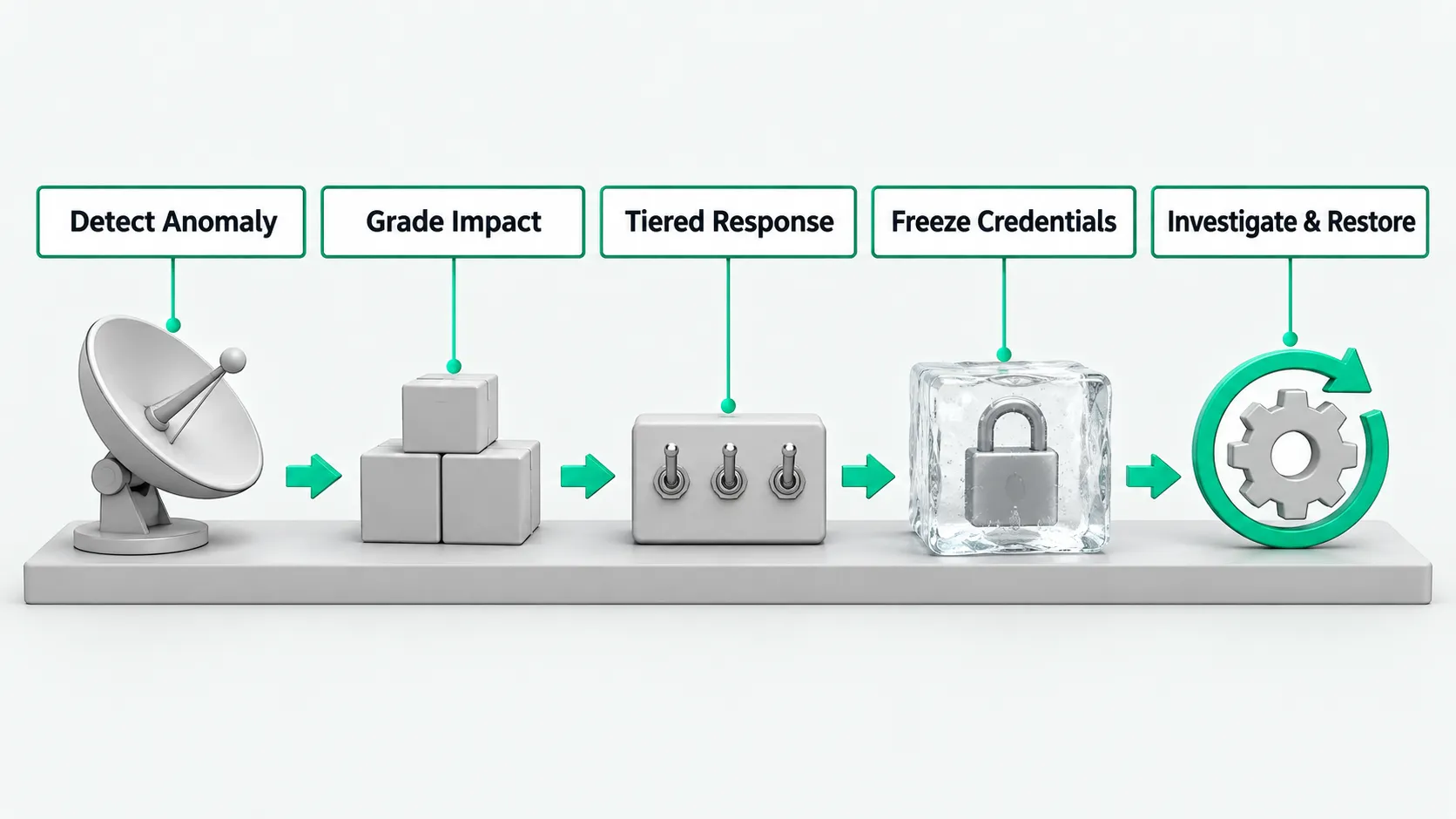
Detect deviation at run time: catch unexpected behavior
The system catches signs of overreach through gateway probes. The program monitors the agent’s tool calls and data queries and compares them with a preset whitelist baseline. If the program tries to call an unregistered internal interface, or asks to read customer tables outside the work order’s scope, the gateway catches it and flags the anomaly.
The comparison algorithm keeps analyzing request frequency and call patterns. The program checks for repeated attempts to probe neighboring network segments and for high-frequency query sweeps in a short time. Besides the automatic probes, frontline staff who see unexpected suggestions in the chat during human-agent work can click “report anomaly” in the admin screen, and the report goes straight into the monitoring pool.
The operations monitoring specialist watches the alert dashboard. The specialist checks the timestamp of the abnormal call, the input context, and the target address the agent tried to reach, and quickly decides whether it is a one-off false alarm or a sustained deviation.
Assess the impact of the overreach: separate reads, writes, and external actions
After finding an overreach, the system first assesses its impact. The program sorts overreach into three types: read-only overreach, internal write overreach, and external action overreach. Read-only overreach means the agent called read-only stores beyond what it needed but did not tamper with data assets. Write overreach means it tried to change database records or configuration files. External action overreach means it tried to send messages to outside parties through email or SMS gateways.
Each tier of tool permission carries a different level of asset exposure. For how to divide tool tiers in advance, see Agent Permission Management: How to Set Tool Access Levels and What to Grant First. Read-only overreach does relatively limited immediate damage to business assets. Internal write overreach can break data consistency. External action overreach can turn directly into a customer complaint.
The security analyst confirms the impact rating. The analyst checks which data tables and which user groups may be affected and confirms the response level for the incident with the response system.
Apply tiered circuit breaking: downgraded operation or a full stop
The system takes different actions by impact rating. For read-only overreach, the system downgrades operation. The gateway revokes the temporary token for that single tool and shrinks the agent’s permissions to basic Q&A, so the business process keeps running. The program records the block in the background and shows on screen that some features are temporarily limited.
For write overreach or external action overreach, the system applies an emergency block. The stop logic in the agent’s execution chain needs a clear floor. For detailed rules on run boundaries and stop design, see Agent Safety Guardrails: When to Stop an Unattended Run. The gateway revokes the agent’s call credentials on the spot, physically cuts its network connection to downstream systems, saves a snapshot of the execution state, and forces a shutdown.
The operations engineer confirms the block took effect. The engineer checks the token revocation status and confirms no background thread is still running, so the block is complete.
Decide who owns the response: how fast to notify business leads
As the block takes effect, incident notification fires immediately. The system sends urgent alerts to the matching roles by overreach level. For a low-level downgrade, the system copies the system administrator and the business contact. For a high-level forced shutdown, the security lead and the head of the business unit get a phone alert and an urgent instant messaging card.
The notification lists the core facts of the incident. The card shows the agent ID, the name of the tool called beyond scope, the controlled asset accessed, the block the system applied, and any unfinished business that may be stuck. After the alert, the business lead quickly assigns people to take over the backlog of work orders, so the shutdown does not stall work on the floor.
The security lead is responsible for deciding whether to widen the isolation. Based on the cause, the lead assesses whether other agents of the same kind in the same cluster have the same flaw and decides whether to investigate them together.
Root cause review and patch verification: reissue authorization and restore
Once the incident is contained, the technical team investigates and reviews. The team pulls the execution snapshot and context messages and checks whether the loss of control came from a manipulated prompt, truncated context, or a hallucination in the underlying model. Engineers reproduce the anomaly in a test environment and locate the root cause.
Engineers fix the flaw and update the defense rules. If the problem was prompt injection, the team adds a semantic filter at the input gateway. If the permission description was vague, engineers tighten the interface’s input and output constraints. After the fix, the security team replays the test set in a sandbox to confirm the defense blocks that kind of call reliably.
The business lead and the security director both sign to approve going back online. Technical staff issue the agent new permission credentials and restore tool access step by step. In the first period after relaunch they set audit rules twice as dense, and lift the watch status once the agent runs stably.
Agent authorized scope: FAQ
Why can’t an algorithm restore an agent on its own right after an overreach?
An overreach shows that the agent’s decision logic or control rules have an undetected flaw. If the algorithm is allowed to reset and restore itself after a block, it often falls into the same faulty logic again on the same or similar business input, and accumulated state can make the error worse. Restoring operation needs a human engineer to find the root cause and patch the flaw, and a security lead to sign off, to break the chain that would let the same risk recur.
When an agent overreaches in read-only mode, why revoke a single tool first instead of shutting it down?
Read-only overreach usually involves only attempts to read unauthorized information. It does not directly damage the underlying business database or issue external payment instructions. Shutting down a whole system that handles daily business because one tool misbehaved would stop every work order in progress and cause a serious business outage. Revoking the probed tool first and running in a downgraded state closes the data leak and keeps core business running.
When a company handles agent deviations, who decides on cross-department overreach responses?
The company’s information security lead and the head of the business line concerned jointly hold final decision authority on cross-department overreach responses. The security department holds the system logs and knows how severe the flaw is, and assesses risk to the network and data assets. The business department knows how urgent the business flow is, and assesses the commercial loss from a shutdown. For full shutdowns and credential freezes, the security lead leads the decision. For business takeover and restoring operation, the business lead confirms jointly.