
Enterprise AI
Customer Service Refund Agents: Which Amounts Need Approval?
When e-commerce and retail companies launch a customer service refund agent, refund limits are controlled by amount tiers the company sets itself. Small requests that fit the order status and reason rules can go through directly. Requests over the limit, repeated requests, and compensation go to a store manager or finance for approval, and the business system rechecks before execution.

Which refunds a customer service refund agent must send to a person depends on the amount tiers and after-sales rules the company sets. If the amount falls inside the company’s small-amount tier and both the order status and the refund reason fit the rules, the tool can be configured to issue the refund directly under the rules. Anything over the tier limit, repeated requests from the same customer in a short period, reasons not in the rules, and anything involving compensation go to the customer service supervisor or finance for approval. The customer service supervisor and finance maintain the refund tiers and rules. The agent can read them but not change them. At the moment of payment, the business system rechecks the request and enforces idempotency.
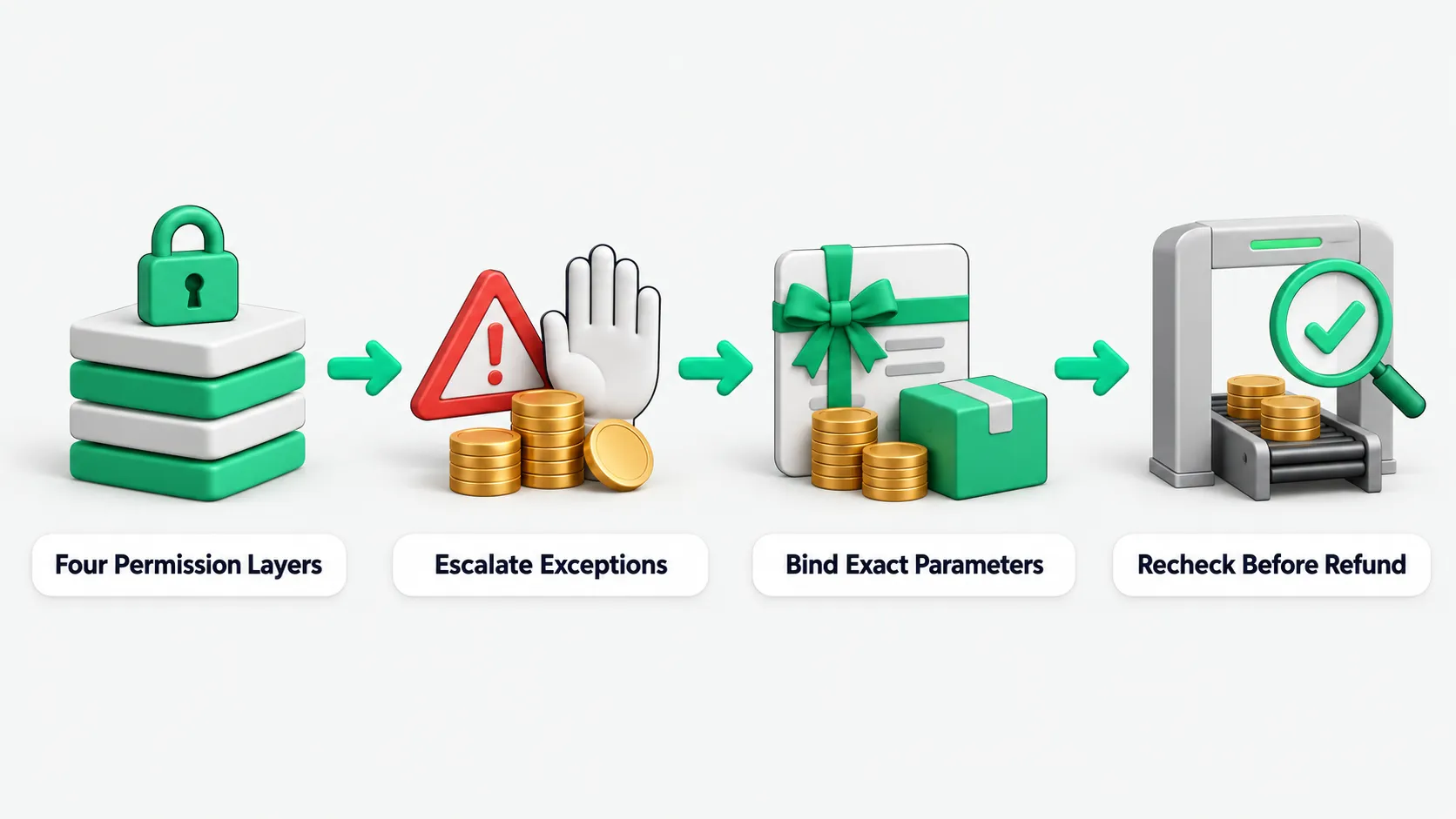
How refund limits are tiered
Before automating after-sales, separate what the agent says from the money it sends back. Front-end reply wording is covered in AI Customer Service Compliance: Who Owns What the Bot Promises?. This note covers only the act of sending money back and the approval of refund amounts. One agent refund involves four separate questions, and one approval cannot cover all of them:
- Can the agent reach the refund tool at all: in routine customer Q&A, the agent can be configured to only look up orders. Anonymous visitors never see money-related tools.
- Does this refund need a person’s approval: this depends on the refund amount. Some refunds need approval every time, and others need it only above a set threshold. The company sets the tiers.
- Who approves once approval is triggered: route by amount tier to the store manager, finance, or the office automation (OA) approval flow, or use the company’s existing after-sales process.
- Is the refund still allowed right now: the business system checks who owns the order, whether its current status still allows a refund, whether the remaining refundable amount covers it, and whether the same refund was already paid.
The customer service supervisor and finance maintain the refund tiers and rules. While the agent runs, it only reads the rules and cannot change them.
Which cases go to a person regardless of amount
If the amount falls inside the company’s small-amount tier and the order status and refund reason both match the rules, the agent can be configured to issue the refund under the rules. In any of the four cases below, the agent stops and sends the request to the customer service supervisor or finance:
- Over the tier limit: a single request exceeds the company’s small-amount limit. It goes up to the store manager, the customer service supervisor, or finance, depending on the tier it falls in.
- Repeated requests from one customer: the same customer account files refund requests several times within the number of days the company sets. The system can be configured to hold these for manual review.
- Reason not in the rules: the customer’s reason is vague or not in the preset rule table. The tool does not guess. It sends the case to a human agent to verify.
- Compensation involved: any payment beyond the amount actually paid for the original order, such as compensation or goodwill credit, goes to the customer service supervisor or finance.
What exactly gets approved, and how to unify entry points
If approval lives only in one front-end chat window, a request that comes in another way can bypass it. Examples include a ticket from a workplace messaging app, a batch action in the operations back office, an automated job triggered through an API, or a different agent platform. The front-end check then does nothing. The person who clicks “confirm” in a chat box may also not be someone with approval authority. So approval has to sit at a back-end point that no entry path can skip, and the business system makes the final call on whether a refund is allowed. For the control points around moving money, see also AP Invoice Agents That Also Pay: Which Controls Can’t Be Skipped?.
Each approval is bound to exact parameters: which task, which tool, which order number, what amount, what reason, and on whose behalf. If the agent reasons again after approval, it may arrive at a different refund amount. So after approval, the system can be configured to resume only with the original tool and the original parameters. If any parameter changes, the approval is void and a new approval is needed. An approval can be used once. It expires immediately when it times out or is revoked.
Recheck before execution, and keep the records
Time passes between the approval request and the actual refund, and the business facts can change. Another employee may have just refunded the same order manually. The operator’s refund permission may have just been revoked. An earlier partial refund may leave too little refundable balance. Or the order may have moved into settlement or a frozen status. So at the moment of executing the refund, the business system checks order status, refundable balance, and permissions again. If anything does not match, it can be configured to reject the call even though it was approved.
The refund execution API must also be idempotent. A unique request ID ensures that a retry does not pay the same refund twice. Everything from the agent’s request, through the approval, to whether the refund finally went through is kept under one task ID for later review.
Customer service refund agents: FAQ
The customer service supervisor says “approved” in a group chat. Can the agent pay the refund?
No. A reply in a chat window or work group cannot verify that the person has approval authority under company policy. It also cannot bind the approval to a specific order number and refund amount. Every refund that needs approval goes through the unified back-end approval flow for the store manager, finance, or OA. Payment is released only after a single-use approval that names the task, the tool, the order number, and the amount.
The store manager already approved. Why did the system still block the refund at execution?
Time passes between the approval and the payment, and the business facts may have changed. If during the wait another employee refunded the same order manually, the remaining refundable balance became too small, the operator’s refund permission was revoked, or the order moved into settlement or a frozen status, the business system catches it in the recheck before execution and rejects the call even though it was approved.
Who sets the refund limits, and how often do they change?
The customer service supervisor and finance set the refund limits together, based on product category, typical order value, and past refund data. They define an approval-free small-amount tier and the approval tiers above it, and write them into the rule base. Any later change to the tiers also goes through the approval process, with the effective date recorded. While the agent runs, it only reads the rules and does not change the refund limits.