
Enterprise AI
Personal Data Agents: How Far Can Customer Data Go?
When a company uses an agent that handles personal data for customer service, it needs clear data access boundaries at each step. The system takes less and reads only required fields. It masks input dynamically, filters fields before external tool calls, and clears and destroys conversation logs on a schedule. A human channel handles customer deletion requests.

A personal data agent handles customer inquiries, order follow-ups, and returns for a company. How far customer private data can go needs a clear floor. A company must not grant a large model free read access to whole back-end tables. Fields should be split into fine-grained, on-demand requests. Take fewer non-essential fields, mask data before calling external interfaces, and clean and archive logs on a schedule, to prevent data leaks.
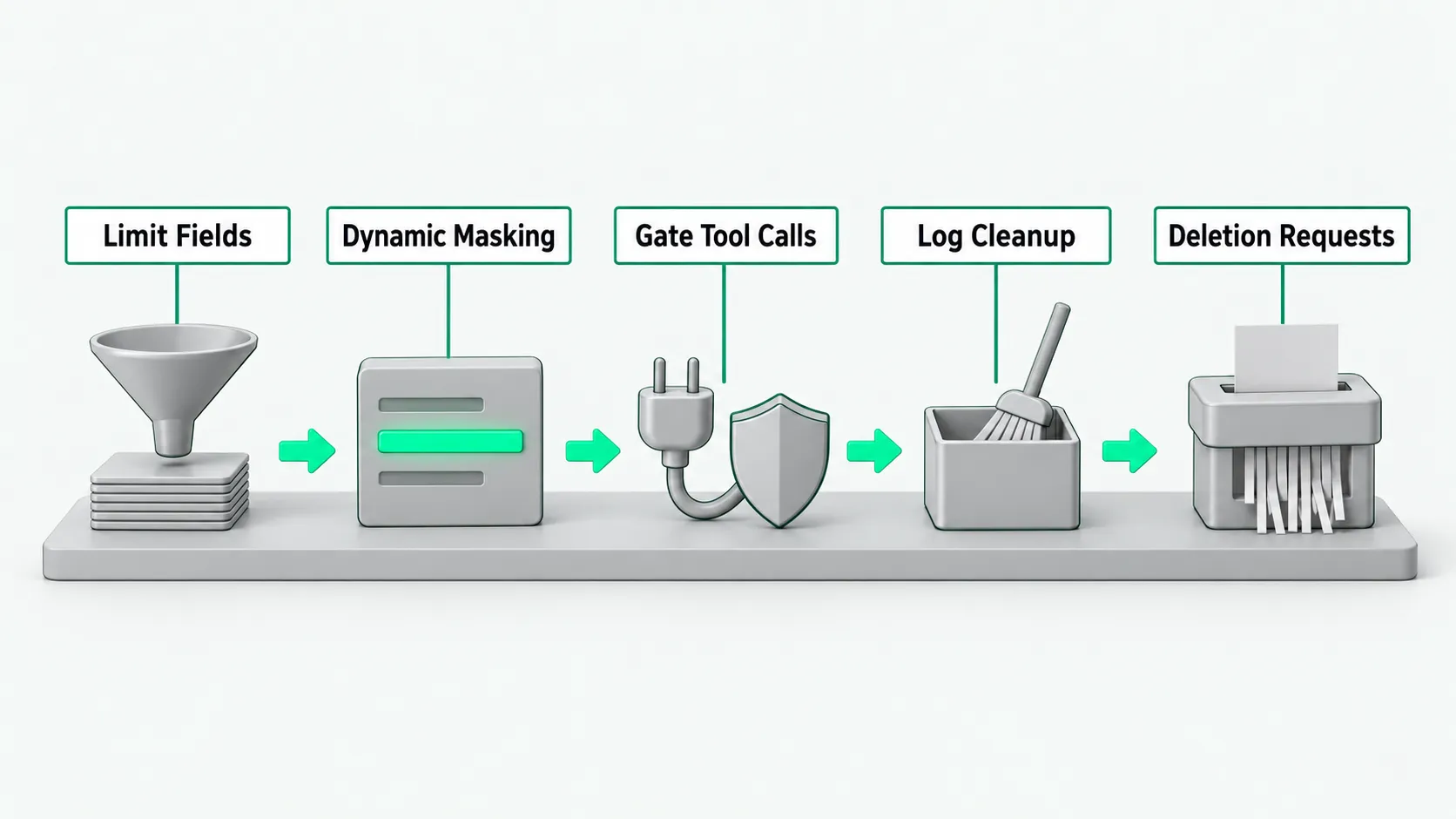
Limit read fields by task: take less non-essential data
When the program receives a customer request, it first sets the field scope from the conversation intent. If the customer asks about delivery progress, the program requests only the order number, tracking number, and delivery city from the order system. It does not pull the ID number or payment account details. The system sets a field-filtering gateway at the database read layer, and fields outside the whitelist are blocked at the interface layer.
The system configures a separate query view for each business scenario. The exchange scenario reads only the purchased product model and the exchange address. The pre-sales scenario reads only public product specs and the user’s nickname. If a user volunteers personal information unrelated to the current task during the conversation, the program detects it at the parsing layer and does not pass it into later business processing.
The data governance specialist defines the field whitelist for each scenario. The specialist reviews the system’s call parameters against each business line’s needs and rejects any direct grant of a whole table or wide table.
Process input and mask sensitive data: hide it before it reaches the screen
Before customer information enters model inference, the program calls a local masking middleware. The program scans input text for phone numbers, ID numbers, and street addresses, and replaces the key digits with mask characters. To understand the meaning, the model only needs to know this is a valid contact detail. It does not need the actual number.
In everyday text and business documents, how sensitive data is masked directly affects the security level. For a side-by-side comparison, see Should You Paste a Contract into ChatGPT? Redact It First. The masking middleware runs in a local controlled environment. The mapping dictionary lives only temporarily in memory and is released from the cache as soon as inference finishes.
Customer service technical support staff spot-check the masking quality. They regularly feed in nonstandard, handwritten test text to check whether the model still detects and masks sensitive numbers in rare abbreviations or altered input.
Gate external tool calls: keep data from leaking through calls
When the program calls an external extension interface or a third-party plugin, the system runs a second outbound check. The security gateway holds the data package bound for the external service and checks whether the message body carries unauthorized plain-text customer information. If the call parameters contain a real phone number or full address, the gateway blocks the outbound request on the spot and raises an alert.
For cross-system integration and third-party protocols, security admission rules come first. For the checklist, see MCP Security Risks: Which 4 Items Should You Review Before Connecting?. When the program connects to an external logistics lookup tool, it sends only hashed identifiers or a coarse administrative region. Sending raw sensitive data is prohibited.
The security engineer manages the communication permission table for external tools. The engineer defines the input and output protocol for each external interface and closes any reverse data-scraping channel from external tools.
Clean memory and archive logs: keep no redundant plain-text credentials
After a conversation ends, the program de-identifies and fixes what goes into long-term memory and system logs. The system keeps only business conclusions, for example that a refund request for an order is complete. It does not keep the full conversation text with the customer’s real name and address in the model context long term. When the model serves the same customer again, it uses a back-end identifier to pull the required fields again under current permissions.
Sensitive fields in audit logs are also encrypted dynamically or hashed. Run logs keep only the request time, the work order number, and the interface response status code. Contact details in request messages are stripped or encrypted. The system runs automated cleanup and deletes temporary interaction data past its retention period on a schedule.
The operations engineer monitors the log cleanup jobs. The engineer checks the wipe records on storage media on a regular schedule, so expired data does not remain on backup media.
Customer rights requests and deletion: set up a human-verified destruction channel
When a customer asks to access, correct, or fully delete their personal data, the system directs the customer to the compliance rights channel. Using the verification credentials the customer submits, the program searches the company data platform for all of the customer’s linked data, including past work orders, temporary conversation summaries, and dispatch records, and compiles a structured processing list.
When a customer asks for full destruction of their personal information, a data protection specialist approves it by hand. The specialist confirms in the back end that the customer has no open refund dispute or pending lawsuit, then runs the account closure. The program sends destruction commands to every business system and the vector memory store, and physically erases or irreversibly anonymizes the linked personal information.
The legal specialist keeps the receipts and compliance records for data processing. The specialist confirms in the system that the data was erased and sends the customer written feedback, so the rights request leaves a record for later review.
Personal data agent: FAQ
Why should a personal data agent mask data before passing context to an external model?
Context sent to an external model may be cached or logged by the provider. If plain text with a customer’s name, ID number, or phone number goes in without masking, the data is hard to recover once it leaves the company’s controlled internal network. Masking sensitive fields locally still lets the model understand the meaning and complete inference, and it cuts off the risk of sensitive data leaving at the source.
When a customer asks the company to delete all past interaction records, how should a personal data agent respond?
After receiving a deletion request, the personal data agent should pause personalized recommendations for that customer’s account and call the platform’s rights interface to generate a list of data to delete. The algorithm must not wipe vouchers needed for financial reconciliation on its own. A human data specialist has to verify. After the specialist confirms there are no open orders or disputes, the specialist triggers the platform’s erasure interface, which clears vector memory and past conversations, and the system sends the customer an account closure certificate.
When a company uses a personal data agent, who sets the data minimization review standard and the field whitelist?
The company’s legal and compliance department, the information security team, and business owners jointly set the data minimization standard. Each department lists the data for each business scenario and decides the minimum fields a task needs. Non-essential fields must not be opened to the program. The security team turns the whitelist into blocking rules on the data gateway. The compliance department reviews field access records on a regular schedule, so business growth does not expand permissions unchecked.