
Enterprise AI
AI Trains New Line Operators: Do They Still Need a Mentor?
Plants hand part of new line-operator training to an AI system, and the mentor's role stays. The system answers questions about work procedures at any time and tracks weak spots. Mentors focus on correcting motions on the floor, passing on hands-on feel, and enforcing safety. Together they form a workable training split.
After a plant hands new line-operator training to an AI system, mentors still have to train new hires. The work needs a new, clear split. The system can explain work instructions again and again, answer terminology questions at any time, and record weak spots. The mentor watches how a new hire applies force, corrects unsafe habits, and signs off on hands-on safety. Separating theory from hands-on experience reduces how much senior workers have to repeat every day, and it protects assembly quality on the line.
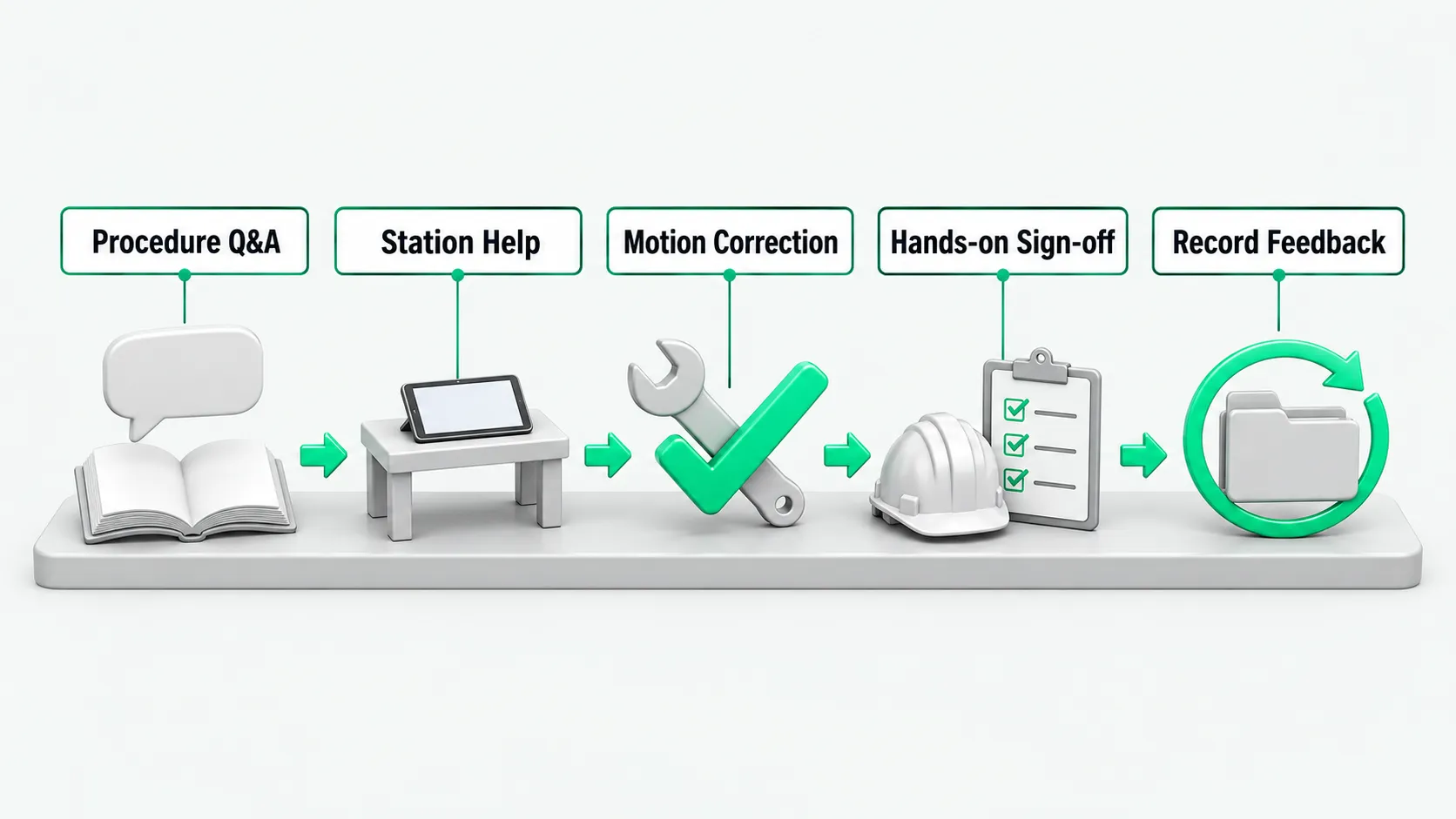
Procedure study and Q&A with the system: explain the work instructions in full
In the first weeks, new hires learn basic processes and safety procedures on an interactive terminal. The system breaks long work instructions into short Q&A items and multi-step cards. New hires can ask questions by voice or text at any time. Whether the question is about the steps for a specific fixture or the tightening sequence for specific bolts, the program explains each item against the current standard.
The system tests understanding of technical terms with simulated scenarios. It shows a typical process diagram and asks the new hire to point out operating hazards or missing steps. It gives feedback and an analysis of the error right away. In the background, the system keeps a learning record for each new hire and marks knowledge gaps where answers were hesitant or repeatedly wrong.
The training workshop supervisor reviews the question bank and the standard answers. The supervisor checks that the drawings and text in the system match the fixtures actually used in the workshop, so outdated drawings do not mislead beginners.
Help at the workstation: answers tied strictly to the current version
During the on-floor internship, new hires call up Q&A help on a tablet beside the workstation. When a worker is unsure of a part code or the order of steps during assembly, they bring up the explanation on screen. Every technical parameter and process step the program gives should come from the effective version in the controlled document library.
Shop-floor knowledge has to be exact. For the underlying architecture choice, see Fine-Tuning vs. RAG: Connect the Enterprise Knowledge Base First. If a new hire asks about an unwritten trick of the trade, the program says plainly that no record exists and tells the new hire to ask the workstation mentor on the spot. The program must not improvise an answer.
The process document administrator keeps the controlled documents in sync. Once an engineering change order takes effect, the administrator updates the index in the back end in one step, so the terminal always serves the latest effective version.
Mentors train hands-on at the station: posture, motion, and feel
Once the theory is learned, hands-on feel still depends on the mentor teaching it on the floor. How vertical the pneumatic screwdriver is when pressed down, the click of a harness clip seating fully, and the faint abnormal sound of a motor on a test run are tacit skills that screen text cannot carry. The mentor stands beside the station, watches the new hire’s stance and hand movements, and stops an awkward use of force on the spot.
Mentors watch most closely for rule violations and safety habits. Examples are whether the new hire wears compliant gear next to a rotating machine tool, and whether they keep their hand out of a sensor’s detection zone when reaching for parts. The mentor builds safety reflexes through hands-on correction. Using the knowledge-gap record the system shares, the mentor drills the new hire on their weak assembly steps.
The team leader pairs mentors with apprentices and schedules shadowing hours. The team leader names a responsible mentor for each new hire and sets the assessment targets for the training period.
System-set theory test and hands-on check: people sign off on safety
At the end of training, the system and the mentor split the competency assessment. The program draws from the question bank to build a personalized theory exam that targets the weak points the new hire got wrong earlier. The system scores it automatically and issues a theory report. Only after passing the theory test can the new hire apply for the hands-on check.
The mentor and a workshop quality inspector run the hands-on check together on the floor. The mentor has the new hire complete several full standard assembly cycles alone and watches cycle rhythm, tool placement, and the self-check routine. The inspector measures every sample the new hire assembled with gauges and confirms dimensional tolerances and appearance have no defects.
The mentor and the workshop director both sign the confirmation form. People are responsible for the pass decision on safe operation and critical processes. After the form is signed and filed, the system sends HR the credential that permits independent work.
Collect errors and improve procedures: drive revisions of work documents
The learning paths and on-floor correction records of all new hires roll up into workshop quality reports on a regular schedule. The system counts the most frequent questions, the most missed test items, and the rework found on the floor for each step, and identifies the operations new hires commonly struggle to understand. While the tool is rolled out, the business process itself has to change too. For that logic, see Company-Wide AI Training Is Done. Why Haven’t Workflows Changed?.
The process engineering team and senior mentors analyze the shared sticking points. If many new hires ask repeated questions about a welding or gluing step and struggle in practice, the current work instruction wording is ambiguous or the process route is hard to follow. Engineers record new demonstration videos and revise the illustrated instructions.
The workshop operations manager runs method-improvement sessions on a regular schedule. The team revises operating standards from the training records and writes the senior mentors’ on-floor feel down as checkable motion points wherever possible.
New line-operator training: FAQ
However clear the AI system is, why can’t it fully replace mentors on the floor in new line-operator training?
Screen interaction can only pass on explicit knowledge. It cannot pass on tacit feel and muscle memory. Line assembly involves sensing force, judging abnormal sounds, and reacting by instinct to sudden spatter. A mentor has to watch these on the physical floor and correct them right away. The AI system takes over repetitive procedure explanations. The mentor focuses on process quality and building safety habits. New hires work safely when both are in place.
When new hires ask questions at the workstation, how do you stop the AI from giving obsolete process parameters?
The system needs strict document lifecycle management. The Q&A engine connects only to the controlled document library that the engineering department has signed off electronically and that is currently in effect. Any draft, in-revision, or withdrawn file is physically isolated. When an engineering change takes effect, the platform automatically invalidates the old index, and each answer shows the current document number and effective date, so frontline work is not misled.
Before new workers work independently, who decides the qualification standard and the sign-off process?
The manufacturing, quality assurance, and safety and environment departments jointly set the qualification standard and who signs. The AI system can generate and grade the theory test. Three people check compliance of hands-on technique, safety awareness, and whether sample measurements meet spec on the floor and sign written opinions: the mentor, the workshop safety officer, and the quality inspector. The person in charge on site carries the final signature responsibility, so the check is not a formality.